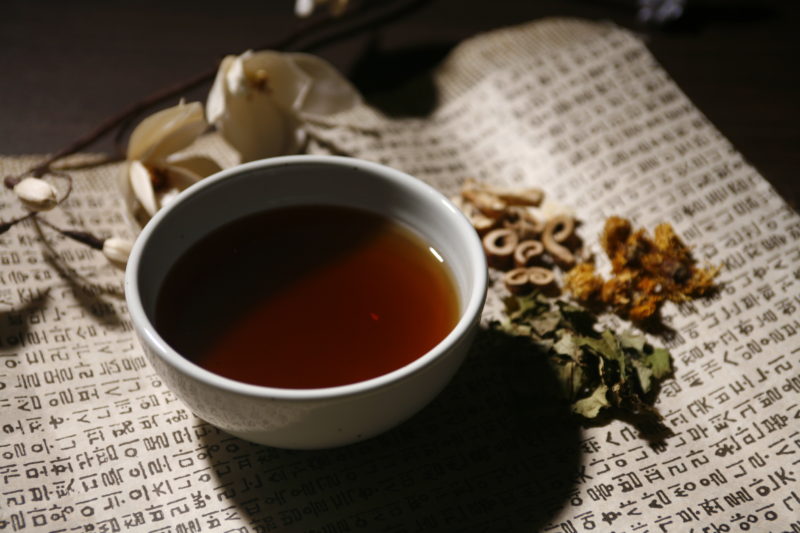
Three traditional foods for lung-clearing
The first of Dr. Seo's ten public lectures introduces the three medicinal foods that anchor the Pyunkang-Hwan formula — Platycodon root, Mulberry bark, and Houttuynia.
2025-12-08 · 8 min read
In Korean medicine the lungs are the central organ of respiration, immunity, and the skin barrier — the body's first line of contact with the outside world. Dr. Seo's first lecture frames why food, more than medication, has historically been used to keep this organ in a balanced, self-clearing state.
1. Platycodon root (桔梗 / Doraji)
Platycodon grandiflorus, known in Korean kitchens as doraji, has been used for over a thousand years as a soothing demulcent for the upper airway. Korean medicine views it as a herb that gently "opens" the lungs — clearing phlegm without the irritation of expectorants, and supporting the body's natural mucosal balance.
It is a daily kitchen ingredient, eaten as a side dish in many Korean households, and is one of the cornerstone botanicals in the Pyunkang-Hwan blend. Its role is constitutional: not a treatment for any one symptom, but a continuous gentle support for the airway.
2. Mulberry root bark (桑白皮 / Sangbaekpi)
The bark of Morus alba (white mulberry) is one of the most studied botanicals in Eastern medicine. Its traditional indication is to "cool the lungs" — to relieve the heat-and-irritation pattern Korean medicine associates with chronic cough, post-nasal drip, and seasonal upper-airway distress.
Modern phytochemistry has identified flavonoid and alkaloid compounds responsible for its observed activity, but the Korean medicine view is older and simpler: when the lungs are clean and cool, breathing follows.
3. Houttuynia (魚腥草 / Eosinju)
Houttuynia cordata, the "fishy-smell herb," is a wild Asian green used as both food and medicine across Korea, Japan, and southern China. In Korean medicine it is paired with Platycodon and Mulberry-bark as a clearing herb — supporting the upper-airway mucosa and the skin's barrier function.
It is the only herb in the Pyunkang-Hwan blend with a recognisably herbal aftertaste. Dr. Seo's lectures repeatedly return to Houttuynia as the formula's quiet workhorse.
Why “food,” not “medicine”
Generations of Korean physicians have classified all three botanicals as “food-as-medicine” — items that belong both on the dinner table and in the clinic. This is not a rhetorical compromise; it is a philosophical choice. If your relationship with an organ is meant to last a lifetime, the support should be everyday, edible, and repeatable — not something that appears only when you are sick.
Platycodon as a side dish, mulberry-bark in soup, Houttuynia as tea — at the Korean dinner table, these have been working for a thousand years. Pyunkang-Hwan combines them into a single daily pellet because modern life rarely allows brewing soup three times a week, but the long-view thinking behind them hasn’t changed.
How to bring the three into daily eating
Platycodon: 5–10 g of dried slices, marinated in honey for a week; 1 teaspoon before breakfast, or added to chicken soup or rice.
Mulberry-bark: 10 g simmered with two thumbs of fresh ginger in 1 litre of water for 20 minutes; sip warm in the afternoon, especially in dry autumn weather.
Houttuynia: steep 5 g of dried herb in boiling water for 5 minutes; one cup a day as a daily tea. If the aroma is strong, add mint or lemon.
None of these replace Pyunkang-Hwan; they let the “lung-skin” line have a daily echo in the kitchen.
"Food and medicine, one source" — millennia of East Asian practice
"Food and medicine, one source" (yao shi tong yuan) is a foundational concept in East Asian medical tradition: many everyday ingredients are themselves medicinal, and medicinal ingredients can be everyday food — the difference lies in dosage and combination. The idea traces back to the *Huangdi Neijing* (Yellow Emperor's Inner Canon) and its dietary framework: "five grains for nourishment, five fruits for assistance, five domestic animals for benefit, five vegetables for filling."
**Platycodon** plays two roles at the Korean dinner table — both as a traditional lung-clearing throat-soothing herb (the *Bencao Gangmu* records: "Platycodon, treating cough and ascending qi, broadens the chest and regulates qi"), and as a common namul (banchan side dish made of root strips) and stew ingredient. Spring and autumn are the traditional Platycodon harvest seasons.
**Mulberry bark** comes from the root bark of the mulberry tree (the *Bencao Gangmu*: "Mulberry root bark, drains the lungs, descends qi, moves water, clears heat"); leaves, fruit, branches, root bark — virtually every part of the mulberry has been catalogued for medicinal use across dynasties.
**Houttuynia (yu xing cao, fish-mint)** has a frank name (its smell is fishy), but in Korea, southwest China, and Southeast Asia it has been a salad, soup ingredient, and tea for over a thousand years. The *Bencao Gangmu* records: "Houttuynia, treats phlegm-heat with rapid breathing, lung abscess, sores and toxins."
These three appear among Pyunkang-Hwan's 20+ herbs not because of personal preference, but as a continuation of this millennia-long food-and-medicine lineage.
Modern phytochemistry — active compounds in the three botanicals
Modern phytochemical research on these three botanicals now spans over 60 years:
**Platycodin / saponins:** the principal active compounds in platycodon root, with reported activities in mucus-secretion modulation, anti-inflammation, and immune regulation. Platycodin D in particular has multiple peer-reviewed reports on anti-inflammatory and antioxidant activity.
**Mulberry-bark flavonoids:** mulberry root bark contains multiple flavonoids (Morusin, Kuwanon C, etc.) with reported antioxidant, lipid-regulating, and bronchodilator activity.
**Houttuynia volatile oils and alkaloids:** the characteristic odour of houttuynia comes from decanoyl acetaldehyde, a compound with antimicrobial activity; it also contains multiple flavonoids (quercitrin, isoquercitrin) and alkaloids.
**Important limitation:** most of this research is in vitro or in animal models; human clinical trials remain a smaller body of evidence. We do not say "these compounds can treat X disease" — but their existence demonstrates that traditional botanicals are not "mysticism"; they carry quantifiable, reproducible biological activity.
Korean home seasons and the three botanicals
**Spring (Mar–May):** harvest tender platycodon roots (wild mountain-grown is prized) for namul or soups. Spring platycodon is sweeter, less bitter, and pairs well with pear and honey.
**Summer (Jun–Aug):** harvest fresh houttuynia for cold side dishes; fresh houttuynia juice (yakcho-jeup in Jeju dialect) is a common summer family drink on Jeju Island.
**Autumn (Sep–Nov):** harvest mulberry root bark (peel and dry it), then simmer with ginger, jujube, and honey. In dry autumn, mulberry-bark-and-ginger broth has been a generational family drink on Korean dinner tables.
**Winter (Dec–Feb):** the honey-preserved platycodon prepared in autumn is taken daily in winter, dissolved in warm water. Paired with winter's dry cold air, this has been a North Korean family tradition for over 200 years.
Pyunkang-Hwan compresses this four-season rhythm of multiple botanicals into a single daily standard dose — allowing a modern, busy life to stay connected to this thousand-year food tradition.
The three roots, in one daily formulation
Pyunkang-Hwan combines these three botanicals with 17+ supporting Korean herbs in a single, daily-dose pellet — refined over 50 years of clinical practice.
Continue reading
Strengthening lung function · the constitutional view
Dr. Seo's second lecture explains why lung wellness in Korean medicine is treated as the foundation of the body's overall constitution, not as a symptom-by-symptom problem.
Diet · RhinitisA Korean herbal diet for rhinitis
Three Korean kitchen recipes — pear-and-doraji soup, schisandra tea, and steamed mulberry-bark broth — for the seasonal weeks when rhinitis cycles back.