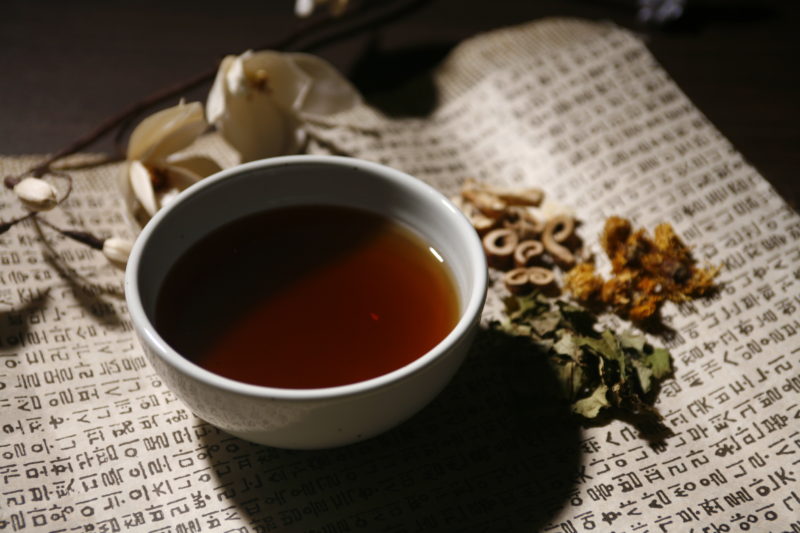
The five primary botanicals
The core of Pyunkang-Hwan is five Korean traditional lung-clearing, lung-moistening, foundation-strengthening herbs, each addressing different layers of the airway and skin barrier.
- Platycodon (Platycodon grandiflorus / Korean: Doraji) — Opens the lung, soothes the throat, dissolves phlegm, drains pus. Considered the lead lung-clearing herb across centuries; commonly served in Korean homes as honey-marinated platycodon root in autumn and winter.
- Schisandra (Schisandra chinensis / Korean: Omija) — Consolidates lung qi, nourishes the kidney, restores fluids, controls perspiration. Schisandrin and other active compounds have a substantial modern pharmacology literature; especially helpful for rhinitis with thin watery discharge.
- Ophiopogon (Ophiopogon japonicus) — Nourishes yin, restores fluids, moistens the lung, calms the heart. Listed in the Korean Pharmacopoeia (KP); a classical formulation choice for yin-deficient lung dryness.
- Mulberry-bark (Morus alba root bark / Korean: Sangbaekpi) — Cools the lung, eases breath, drains water, reduces swelling. A traditional asthma-pattern herb; the foundation of the autumn ginger broth Korean grandmothers brew when dryness arrives.
- Aster (Aster tataricus) — Moistens the lung, descends qi, dissolves phlegm, soothes cough. Especially suited to lung-deficiency chronic cough and nighttime cough.
Fifteen supporting botanicals
Beyond the five primary herbs, fifteen supporting botanicals fill four roles: synergistic heat-clearing, nourishment, spleen-supporting, and harmonising — so the primary herbs neither stand alone nor become too aggressive.
- Lily bulb (Lilium brownii) — nourishes yin, moistens lung, calms the heart
- Skullcap (Scutellaria baicalensis) — clears heat, dries damp, drains fire, detoxifies
- Licorice (Glycyrrhiza uralensis) — strengthens spleen, harmonises herbs
- Honeysuckle (Lonicera japonica) — clears heat, detoxifies, releases external wind-heat
- Houttuynia (Houttuynia cordata) — clears heat, detoxifies, drains pus, promotes urination
- Tangerine peel (Citrus reticulata) — regulates qi, strengthens spleen, dries damp, dissolves phlegm
- Cinnamon bark (Cinnamomum cassia) — warms the channels, opens vessels, supports yang
- White atractylodes (Atractylodes macrocephala) — strengthens spleen, dries damp, regulates water
- Poria (Wolfiporia cocos) — drains damp, strengthens spleen, calms the heart
- Angelica (Angelica sinensis) — nourishes blood, regulates menstruation, soothes pain
- Chuanxiong (Ligusticum chuanxiong) — invigorates blood, regulates qi, releases wind
- Wolfberry (Lycium barbarum) — nourishes liver and kidney, brightens vision
- Chinese yam (Dioscorea opposita) — strengthens spleen, restores fluids, supports lung and kidney
- Lotus seed (Nelumbo nucifera) — strengthens spleen, supports kidney, calms the heart
- Job's tears (Coix lacryma-jobi) — drains damp, strengthens spleen, clears heat, drains pus
Why "food as medicine"
More than half of the 20+ botanicals also appear on Korean dinner tables as ingredients or teas (platycodon banchan, schisandra tea, Job's-tears porridge, Chinese-yam soup, lotus-seed dessert). This is not coincidence — Korean medicine classifies these as "food-as-medicine," meaning everyday eating has been doing the work for a thousand years. Pyunkang-Hwan simply concentrates them into a once-a-day pellet.
This is also why Pyunkang-Hwan is sold in the US as a traditional food supplement, not as an FDA-regulated drug.
Korean GMP-certified manufacturing
Pyunkang-Hwan is manufactured in a Korean GMP (Good Manufacturing Practice) certified facility. GMP certification covers six dimensions: facility environment, raw-material storage, process control, personnel training, finished-product inspection, and batch traceability — all audited annually on-site by the Korean Ministry of Food and Drug Safety (MFDS).
The facility uses low-temperature extraction (under 60°C) to preserve botanical actives and avoid heat degradation. The concentrated extract is mixed with food-grade excipients (microcrystalline cellulose, maltitol), formed into 0.5g spherical pellets, and finally nitrogen-flushed for shelf-life preservation.
Per-batch testing: heavy metals + microbial + active compounds
Incoming raw materials: tested by a Korean national-accredited lab for the four major heavy metals (lead ≤ 1.5 ppm, cadmium ≤ 0.3 ppm, mercury ≤ 0.1 ppm, arsenic ≤ 1.5 ppm), residual pesticides (370+ analytes), and microbial counts (total plate count, E. coli, Salmonella). Any failed parameter sends the entire batch back.
Finished product: sent to SGS (third party) for quantification of active compounds (Schisandrin, Platycodin D), ensuring batch-to-batch consistency. Each bottle is printed with a batch number — customers can email [email protected] to request that batch's full test report PDF.
Composition disclosure & safety
Pyunkang-Hwan is a traditional food supplement. It contains no steroids, no Western pharmaceuticals, no caffeine, and none of the major declared allergens (gluten, dairy, tree-nuts, shellfish).
If you are on long-term prescription medication — especially anticoagulants (warfarin), antihypertensives, immunosuppressants — please tell your physician before starting Pyunkang-Hwan. Our customer service can translate the full ingredient list for your physician on request.